
Module 2 : Evaluation
Appreciation
In the present section an assessment of the performance of the Training Course Module 2 is presented, based on the responses to the questionnaires completed by the participants.
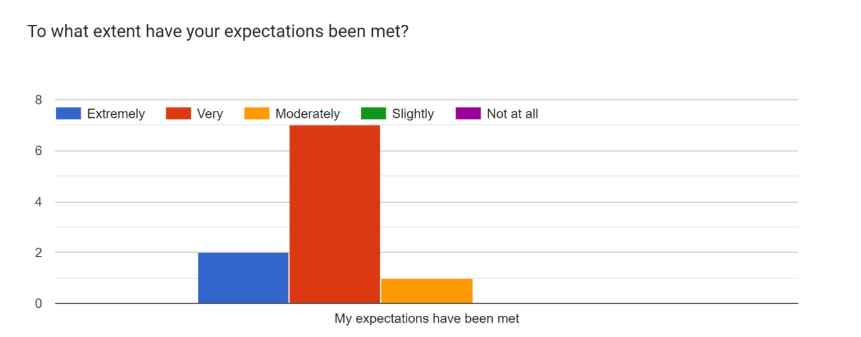
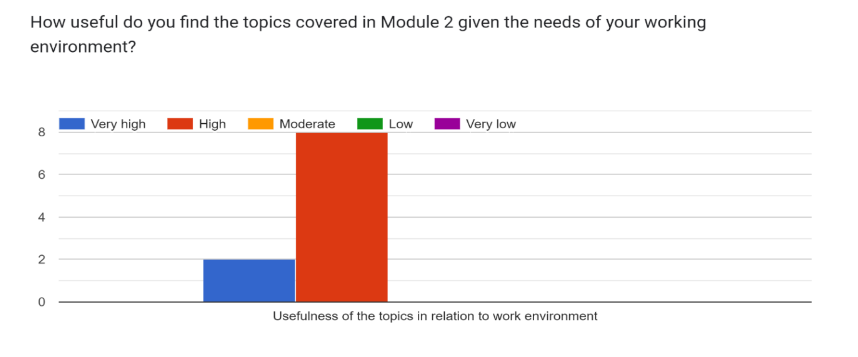
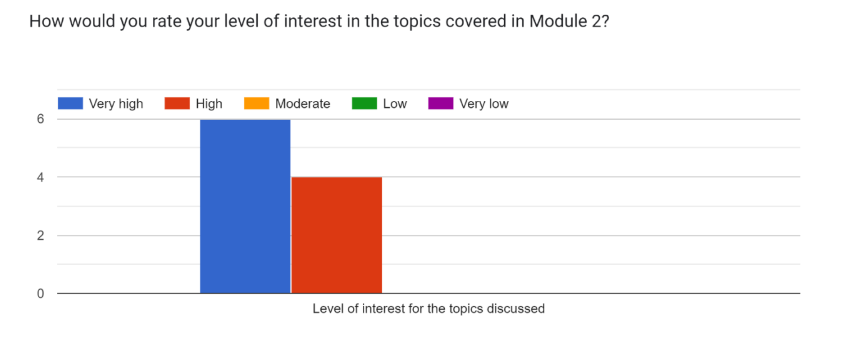
As shown in the graphs below, the expectations of the majority of participants were met. Only one person stated that her/his expectations were met moderately. The level of interest in relation to the topics was reported as very high by the majority of the participants (6 out of 10 participants) and the usefulness of the topics covered was rated as high (8 out of 10 participants) or very high (2 out of 10 participants).
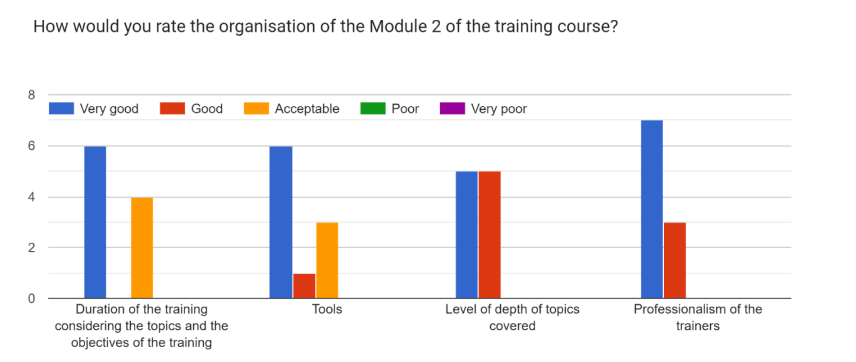
The organisation of the modules was considered very good by the majority of the participants, considering:
-duration of the training (6 out of 10 participants);
-Tools (6 out of 10 participants)
-level of depth of the topics covered (5 out of 10 participants)
-professionalism of the trainers (7 out of 10 participants)
Four people assessed the duration of the Module 2 as acceptable and three people rated the tools used as acceptable.
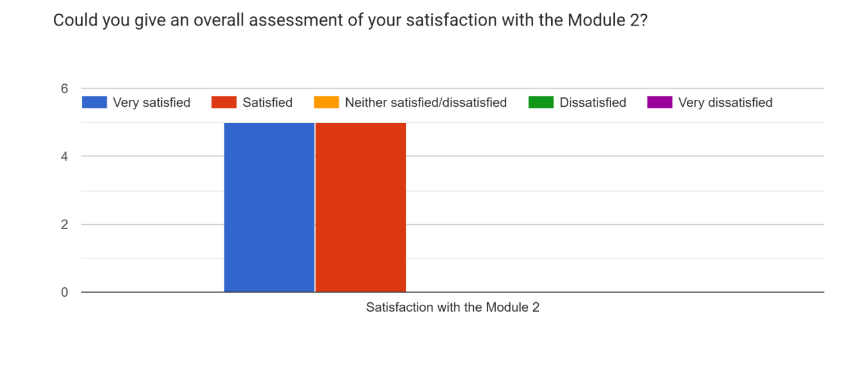
The overall assessment of participants satisfactions regarding Module 2 indicates a good performance: 5 participants out of 10 declared themselves as very satisfied, while 5 participants out of 10 declared themselves satisfied.
Learning Assessment
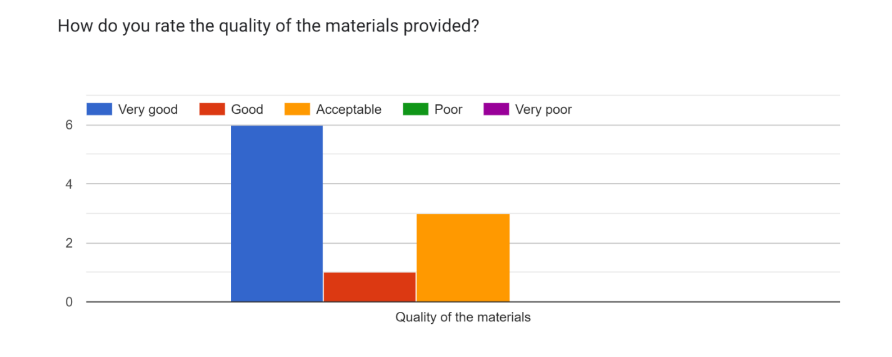
Concerning the learning assessment, the quality of the material provided was rated as very good by 6 participants, with 1 participant rating it as good and 3 participants considering it acceptable.
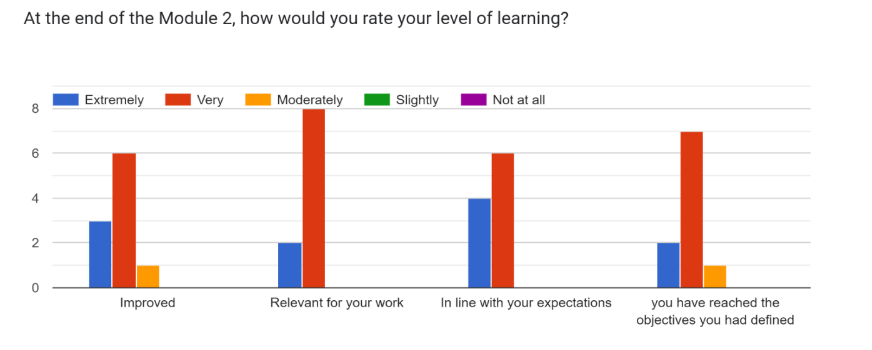
The level of learning was assessed as follow:
– improved by 6 participants and moderately improved by 1 participant; 3 participants assessed their level of learning as extremely improved;
-extremely relevant for the job by 2 participants; very relevant for the job by 8 participants;
-extremely in line with their expectations by 4 participants; very in line with their expectation by
6 participants;
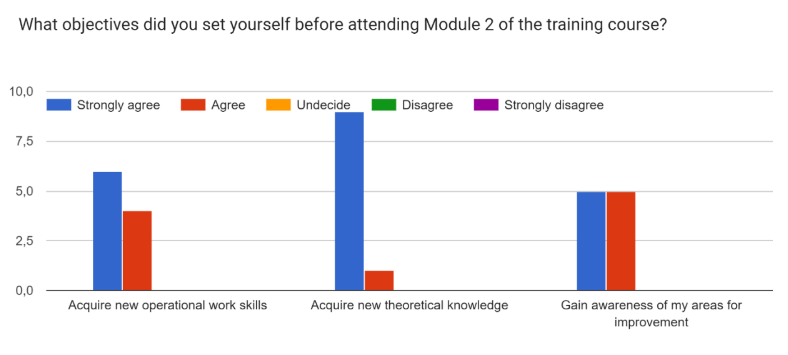
Participants indicated they achieved the objectives they had defined (very: 7 out of 13 participants; extremely: 3 out of 13 participants; moderately 3 out of 13 participants).
Furthermore, participants expressed the following sentiments:
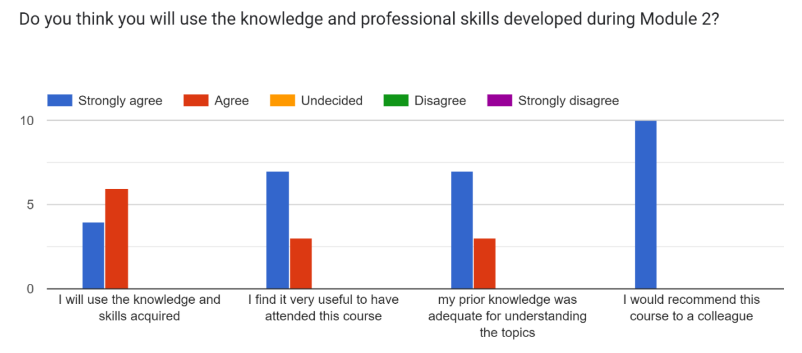
– they will use the knowledge and skills acquired during the training (strongly agree or agree)
– they would recommend the training course (strongly agree)
– they found it very useful to have attended the course (strongly agree or agree). Three participants are undecided and they neither agree nor disagree with this sentence.
-their prior knowledge was adequate for understanding the topics (strongly agree or agree). Only one person is undecided and he/she neither agrees nor disagrees with this sentence.
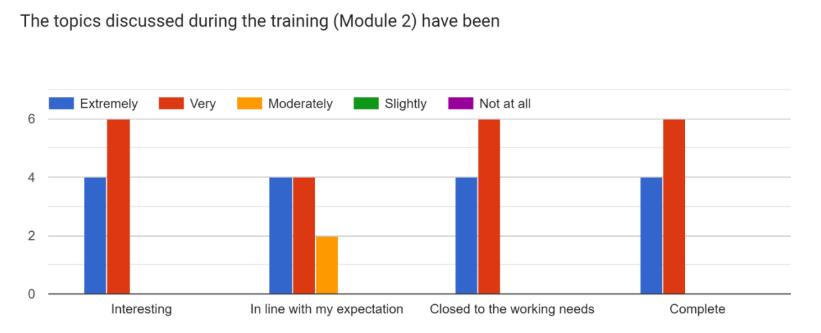
The participants also rated the topics discussed during the training as follows:
-extremely interesting ( 6 out of 10 participants); in line with their expectations (8 out of 10 participants) and closed to the working needs (10 out of 10 participants participants); complete or extremely complete (10 out of 10 participants).
Methodology
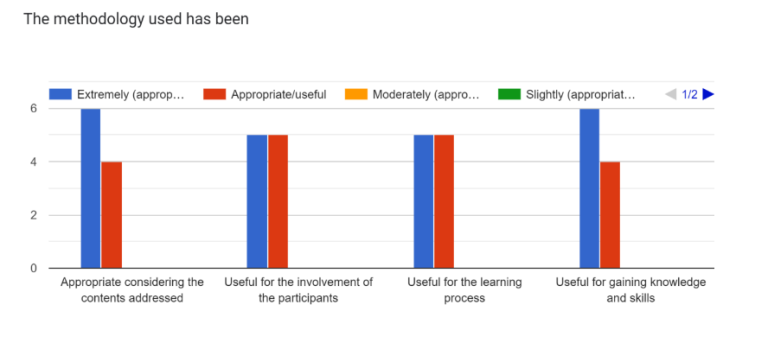
Regarding the methodology employed for the implementation of Module 2, participants assessed it as follows:
– extremely appropriate considering the contents addressed (6 out of 10 participants) or appropriate (4/10);
– extremely useful/useful for the involvement of the participants (5+5 out of 10 participants);
– extremely useful/useful for the learning process (5+5 out of 10 participants)
– extremely useful/useful for gaining knowledge and skills (6+4 out of 10 participants)
Results
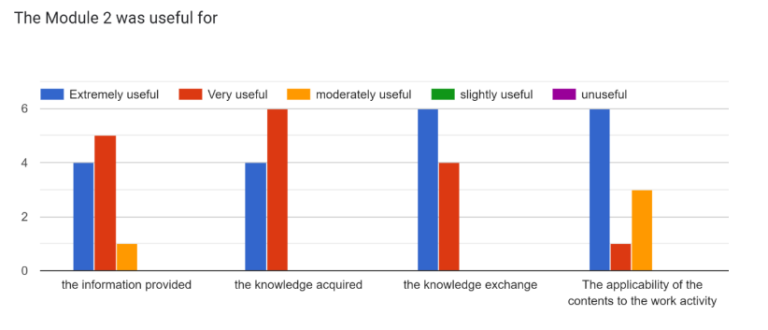
As per the results, the majority of participants evaluated the training course as extremely useful or useful in the following aspects:
– the information provided (9 out of 10 participants);
– the knowledge exchange (10 out of 10 participants)
– the knowledge acquired (10 out of 10 participants);
– the applicability of the contents to the work activity (7 out of 10 participants).
However, three out of ten participants rated Module 2 as moderately useful specifically regarding the applicability of the contents to work activities. Additionally, one participant rated Module 2 as moderately useful considering the information provided.
Additional information
In the “Additional Information” section, participants were asked to respond to specific open-ended questions. Below, you’ll find the analysis of the received responses for each open-ended question.
Please, write 4 positive aspects of the Module
The course was described as very interesting and useful, providing valuable insights into mental conditions. Participants learned to assess their customers’ disorders and gained practical skills for referral. The course increased awareness of mental illness, prompting a commitment to patience, relaxation, and a focus on positive aspects to handle delicate situations effectively.
Overall, participants found the course educational, useful, entertaining, and instructive, offering an opportunity to enhance their own experiences. There was a desire for more knowledge about mental illness and a positive emphasis on the exchange of experiences and finding solutions.
Key highlights include appreciation for:
● Details given and experiences shared.
● Understanding the differences in mental health situations.
● Explanation of when and how to refer.
● Understanding the symptoms of mental health.
In summary, participants valued the course for its practicality, educational content, and the chance to improve their approach to mental health situations. However, some of them would have appreciated a greater focus on solutions to address specific challenges.
Please report any criticalities or issues you encountered during the module.
The course was criticized for being too theoretical with limited practical examples. Participants expressed dissatisfaction with the absence of written materials and suggested the creation of a comprehensive leaflet containing all the relevant information
Which topics of the Module did you understand better?
Participants reported a strong understanding of all the topics covered in the module, with specific emphasis on effective comprehension of strategies for dealing with both mental conditions and mental health conditions. Additionally, there was a focus on information about mental illness, empathy, and recognition of major symptoms associated with mental health conditions.
Which topics of Module 2 did you understand the worst?
When asked about the topics in Module 2 that participants found challenging to understand, responses varied. Some participants indicated that everything was okay, while others specifically mentioned the bio-psycho-social model as a challenging concept. A few participants expressed difficulty understanding a video presentation. Overall, opinions ranged from finding everything perfect to encountering challenges with specific aspects of the module.
Please use this space to add any comments you may have on previous answers and to make any suggestions, comments for improving the organisation of the modules and its implementation.
Participants provided a range of feedback on the course:
Positive Comments:
✔ Expressing a desire to attend more similar trainings.
✔ Suggesting the need for additional practical exercises.
✔ Overall satisfaction with the course.
Suggestions for Improvement:
✔ Requesting more practical sessions and proposing the development of improvement
projects.
✔ Identifying specific topics for future consideration, such as gender, elderly individuals, and
eating disorders.
✔ Expressing a preference for more details on gender-related issues, eating disorders, and
relationships with the elderly.
Evaluation of Informativeness:
✔ Acknowledging the course as very informative.
✔ Indicating a need for personal revision and further understanding at home.
During the training course in Malta, one focus groups was conducted at the conclusion of the second module. The following are the findings that emerged during the discussion. The training course was considered very interesting and useful, and the participants expressed satisfaction. Some participants have indicated that it will be easier for them to manage their emotions and better understand how to deal with certain clients. In particular, they have emphasized the importance of acquiring new knowledge and skills regarding listening and communication. In some cases, they requested practical solutions to understand how to address the needs discussed during the training in particular regarding people with eating disorder; gender transition and elderly people. Some participants have emphasized that they will definitely use in their work the information received during the training course.
Conclusions
The course met participants’ expectations and proved to be both useful and engaging. Participants particularly appreciated the practical component and the sharing of insights from real cases, which they found highly relevant to their work. The information on effective interaction, communication and listening skills was particularly appreciated. Therefore, emphasis should be placed on this aspect of the course, with ample space for practical cases and other specific issues highlighted by some participants, such as the elderly, people with eating disorders and those undergoing gender transition. In addition, participants have requested study materials for further review.